The Hidden Cost of Frontline Disengagement
Why your biggest workforce challenge isn't who you think it is...
The workers keeping your business running are the ones being left behind
Frontline workers are the engine of Australia. They are the nurses, retail assistants, warehouse operators, cleaners, and hospitality staff who show up every day to deliver your product, help the community and own your customer experience. In industries like healthcare, retail, construction, and transport, they don't just represent the workforce - they are the majority.
And yet, they are consistently the last to benefit from the tools, systems, and investment that office workers take for granted.
The result is a disengagement crisis that most organisations are underestimating, and one that is costing them far more than they realise.
The scale of the problem
Disengagement is not a soft HR metric. It has a direct and measurable impact on productivity, compliance, retention, and customer experience.
Gallup's 2024 research estimates that disengaged employees cost the global economy $8.8 trillion annually in lost productivity. At an individual level, each disengaged employee costs a business the equivalent of 18–34% of their annual salary. For an organisation with a large frontline workforce, those numbers compound quickly.
The frontline picture is particularly stark:
- Only 13% of frontline workers report feeling engaged at work, according to Gallup.
- 55% of frontline workers considered quitting in the past year, and 66% report work-related stress, according to Quinyx's 2024 report.
- Only 17% of frontline workers feel highly enabled and supported in their roles.
- Replacing a single frontline employee costs between $3,000 and $5,000, according to the Society for Human Resource Management - a figure that compounds rapidly in high-turnover environments.
For people managers, this is not a future problem. It is happening now, on every shift, in every location.
Why is this happening?
The disengagement crisis in frontline workforces is not caused by a lack of investment in HR systems. Most organisations have invested significantly in platforms for payroll, rostering, compliance, learning management, and employee communications.
The problem is access.
Only 23% of frontline workers report having access to the digital tools they need to stay productive. The systems that organisations have invested in are, in most cases, built for desk-based workers, people with a company laptop, a corporate email address, and time to sit down and navigate a system. They were never designed for someone checking their phone between shifts, working across multiple sites, or operating in environments where logging into a browser-based portal simply isn't practical.
Research shows that 74% of leaders believe they are investing adequately in frontline technology, but only 39% of workers agree. That gap between perception and reality is where disengagement lives.
The tools are there. The investment has been made. But for many frontline workers, those systems remain invisible and the experience of disconnection that results drives exactly the turnover, compliance failures, and disengagement that people managers are trying to solve.
The real costs hiding in your workforce
Turnover and recruitment
High turnover is the most visible cost of frontline disengagement, but it is rarely tracked against its root cause. When a frontline worker feels uninformed, unsupported, or disconnected from their organisation, they leave, and the cost of replacing them is immediate and significant.
Companies with high employee engagement experience 43% lower turnover. For an organisation with hundreds or thousands of frontline staff, closing even a portion of that gap has a material impact on the bottom line.
Compliance risk
Frontline workers in industries like healthcare, construction, retail, security and transport operate in heavily regulated environments. Licence renewals, safety certifications, induction records, and policy acknowledgements are not optional, and the consequences of non-compliance range from regulatory penalties to serious safety incidents.
When communication relies on email, notice boards, or manual follow-up, compliance becomes a function of luck rather than process. Workers miss renewal dates. Policy updates go unread. Incident reporting is delayed or incomplete.
Productivity and operational efficiency
Teams with high disengagement see 18% lower productivity and 15% lower profitability. For frontline organisations where margins are already tight, that drag is significant.
Much of this productivity loss is invisible; time spent by managers chasing roster confirmations, answering repetitive queries, or managing manual processes that a connected workforce would handle themselves. It is the cost of friction, and it accumulates across every shift, every day.
Customer experience
PwC found that 73% of consumers view customer service as a key factor in their purchasing decisions. In retail, hospitality, and healthcare, the quality of that experience is determined almost entirely by frontline staff. A disengaged, under-informed workforce does not deliver a consistent customer experience, and the reputational cost of that is difficult to quantify but easy to feel.
What closing the gap looks like
The good news is that the investment most organisations need to make is not in new systems. It is in making existing systems accessible to the people who need them.
The most effective approach is a mobile-first layer that sits on top of existing HR infrastructure, connecting payroll, rostering, compliance, learning management, and communications into a single, intuitive experience that frontline workers can access in two taps on their own phone. No laptop required. No corporate email needed. No training necessary.
The impact of this approach is well documented across organisations that have made the shift:
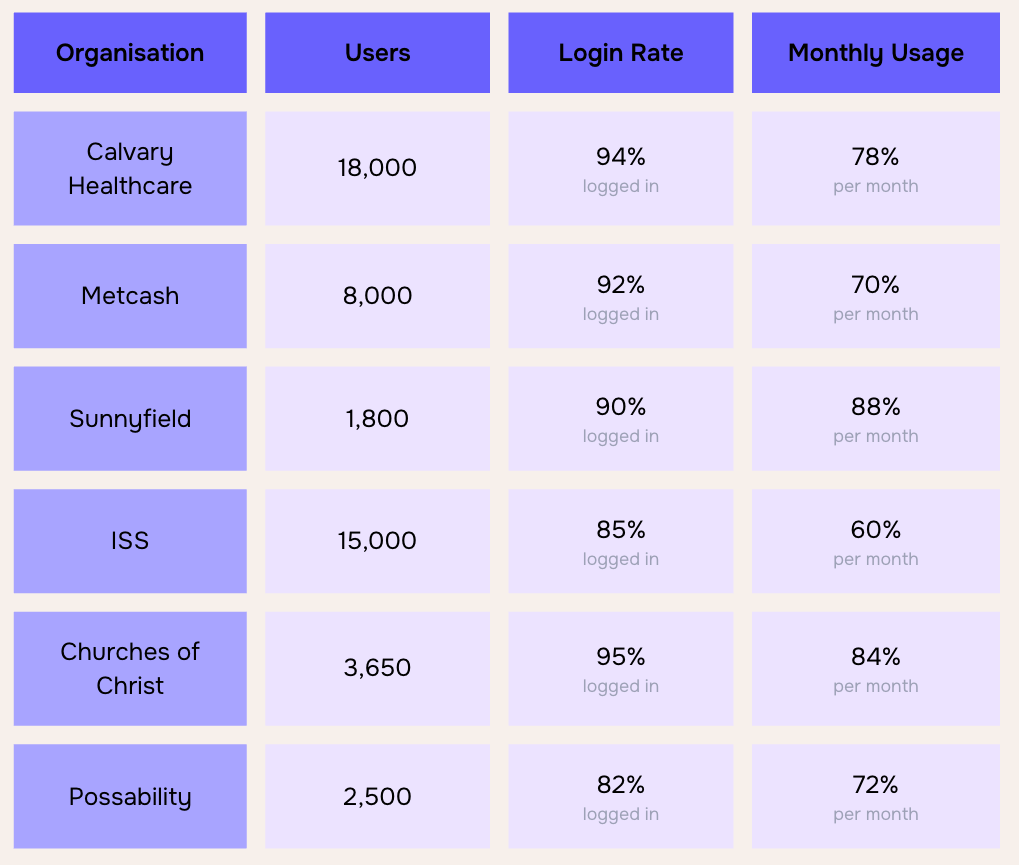
These are not engagement scores from a survey. They are active usage rates from real frontline workers, on their own devices, checking in an average of 10 times per week.
The change management advantage
One of the most underestimated benefits of a connected frontline workforce is what it does to the cost and complexity of change management.
Organisations going through system transitions (new ERP implementations, payroll platform changes, rostering upgrades) typically face months of communication effort, training programs, and adoption challenges. When frontline workers are already connected through a single mobile platform, that burden drops dramatically.
Rather than building a change management program from scratch for every initiative, a connected frontline becomes a channel through which change is delivered - consistently, instantly, and measurably.
A question worth asking
Before your next planning cycle, it is worth asking: of all the systems your organisation has invested in, how many of them are actually being used by your frontline workers?
Not accessed occasionally. Not theoretically available. Actually used daily, by the people doing the work.
If the honest answer is "not many," the cost of that gap is already showing up in your turnover rates, your compliance records, your manager workload, and your customer feedback. It is just not being attributed to its real cause.
The organisations seeing the strongest frontline engagement results are not the ones that have spent the most on new technology. They are the ones that have made their existing investment accessible to everyone - not just the people sitting at a desk.
Sources: Gallup State of the Global Workplace 2024; Quinyx State of the Frontline Workforce 2024; PwC Future of Customer Experience; Society for Human Resource Management (SHRM); McKinsey & Company Human Capital Research 2024.
Author: Rachel Muston
Download your
free whitepaper!
Notes from the Frontline. We'll email it straight to your inbox!

Give your frontline team
the employee experience they deserve.
Let's chat about your current challenges and how Mumba can help!
Flexible & scalable packages · Dedicated onboarding support · Live in weeks
Download the free whitepaper.
Your data is safe. We'll only use it to send you the whitepaper and relevant content.
Book a discovery session.
Book a 20-minute discovery session with our team to talk through your current challenges, see how other providers are approaching them, and explore whether Mumba is the right fit.
We'll get back to you within one business day.